
Thanks very much to Nigel for inviting me to present on REST at St George Bank in Kogarah, and to ThoughtWorks for the time in the middle of the day to give the talk. It was a fun session and the people attending asked quite a number of good questions. Here are the slides. Please note that they are about 10mb (thanks to all the images). There’s some extra information in the “Notes” pane as well.
Category: Technical Page 8 of 15
 Packt Publishing kindly sent me a copy of RESTful PHP Web Services by Samisa Abeysinghe to review. The book’s cover claims that it will help you “Learn the basic architectural concepts and steps through examples of consuming and creating RESTful web services in PHP”. The book succeeds in providing simple steps and examples of creating and consuming web services, but falls short on REST architectural concepts and design principles.
The book starts with a very brief introduction to the principles of REST, and rapidly moves on to a discussion of PHP tools frameworks. The introduction misses some important REST / RESTful web service concepts such as hypermedia, application vs resource state and the relevance of utilising HTTP headers and status codes. Some of the information in the introduction is confusing. For example, on page 12, it says “Resources can have multiple representations that reflect different application states”. This does sound a little odd – resources can have multiple representations, for example, for different requested content types. Representations should reflect resource state, not application state. Also, the coverage of HTTP verbs is misleading, especially when POST and PUT are discussed.
The next couple of chapters discuss PHP support for HTTP, using libraries such as CURL, and XML parsing strategies. The author chooses realistic examples for code samples, such as Flickr and Yahoo Maps clients. The last example given is quite cool – using earthquake latitudes and longitudes from an Australian government site to plot points on Yahoo maps. The example code is generally simple and easy to follow. However, it would have been nice to see some sort of separation between view and data access logic.
The following chapter is a worked example of building RESTful services for a library lending books. It is a good example, and becomes the basis for most future chapters. The resource design and URLs are reasonable, although it may have been nice to have “loans” as resources in their own right. Using links between resources, rather than just relying on known URLs would also benefit the design.
Later chapters cover alternative frameworks such as Zend and WSO2 using the library lending system as an example for code samples. These chapters are useful as they give an idea how the frameworks look when put in practice. It does look as though PHP and frameworks still have significant limitations around routing flexibility from the examples (eg, the .php extension seems to mandatory in URLs). There is also a chapter on debugging with tips around tools and troubleshooting XML parsing issues.
The writing style is generally clear and easy to read. There are occasionally some odd turns of phrase, such as on page 10: “AJAX makes Web applications to become more interactive, faster, and more user-friendly”.
Overall, I would recommend this book to people wanting to write simple URI template based web services or clients in PHP, and also to people interested in getting an overview of libraries and frameworks currently available in the PHP ecosystem. To gain an understanding of the REST architectural constraints and designing good RESTful systems, I would recommend RESTful Web Services, and if you wanted to take it further, digging into Roy Fielding’s thesis and the HTTP 1.1 Spec.
“JavaScript: The Good Parts” was kindly lent to me by my friend and colleague Dave Cameron. It was a highly informative read, and a good length at just under 150 pages. The aim of the book is to define an elegant, recommended subset of JavaScript that allows you to do everything you need, and work around problems in the language. The book is aimed at people who already have a good grasp of programming in other languages.
I learnt quite a bit from the book. Here are a few of the most important parts that come to mind:
- JavaScript has function scope, not block scope so it is best to declare variables at the top of functions.
- It is important to put { on the same line as the block opening keyword (eg, function, if etc) rather than on the next line. Otherwise, you may run into problems with some JavaScript implementations auto-adding ; in the wrong place.
- Using the === and !== operators are safer and better than the == and != operators as they do no coerce types.
- The ‘new’ operator is a bad way to make new objects in JavaScript and should be avoided. Functions starting with a capital letter should always be called with the new operator by convention. Failing to do this will add all the functionality of the object you are trying to create to the global object (thanks to the this references)!
- You can always pass any number of arguments to a function. Extra arguments are not bound to function parameters, missing arguments will be undefined. Inside the function all arguments are accessible using the ‘arguments’ variable which is an array-like object.
- Lots of things are false. Eg, 0, NaN, empty string, null, and undefined.
- hasOwnProperty(name) is great in for(property in object) loops to find members of your object rather inherited members.
- Object.beget(someOtherObject) allows prototypal inheritance from someOtherObject.
- JavaScript arrays are really just objects with numerical property names and the length property, so if you use a for in loop, you’ll get indices in random order.
- It is a good idea to ‘namespace’ your code in a single global variable for your application to avoid conflicts with other libraries. Eg, myApp = {}; myApp.myVariable = 5;
- If you don’t used var, a global variable is created.
- Closures let you make information private and give you encapsulation.
- Inner functions have access to the variables defined in an outer function.
Creating objects with private data:
var incrementer = function() {
  var value = 0;

  return {
    increment: function (inc) {
      value += typeof inc === 'number' ? inc : 1;
    },
    getValue: function() {
      return value;
    }
  };
};

var myIncrementer = incrementer();
Functional inheritance
var mammal = function(spec) {
  var that = {};

  that.getName = function() {
    return spec.name;
  };

  return that;
};

var myMammal = mammal({name: 'Fred'});
myMammal.getName() === 'Fred'

var cat = function(spec) {
  var that = mammal(spec);
  var super_getName = that.superior('getName');

  that.purr = function { /* new catty stuff */ };

  that.getName = function {
    return super_getName() + ' the Cat!';
  };

  return that;
};

var myCat = cat({name: 'Kitty'});
myCat.getName() === 'Kitty the Cat!'

// Helpers

Object.method('superior', function(name) {
  var that = this, method = that[name];
  return function() { return method.apply(that, arguments); };
});

Function.prototype.method = function(name, func) {
  this.prototype[name] = func;
  return this;
};
There were a few things that I thought could be improved in the book. First of all, although the structure was adequate, it did lend itself to repetition. For example, scope is covered on p36 (in Functions section) and p102 (Awful parts), with very similar words. Secondly, I did not find the frequent syntax diagrams added much to the narrative.
Despite these small blemishes, I’m glad to have read Crockford’s book. I now understand much better which parts of JavaScript to use, and how to build good object oriented code in JavaScript.
When defining an XML document, when are attributes most appropriate, and when are elements best? This is something that I’ve generally decided based more on intuition than a good set of rules.
Recently, at work, the need has arisen to define quite a few XML message payloads. I’ve also had the good fortune to work with Erik Doernenburg and we had a chat about attributes vs. elements. Largely thanks to Erik, here are some guidelines that could come in handy when making such a decision.
An attribute is best used to represent:
- an id
- metadata (eg, like rel and class in HTML)
- a value from a small, closed set of values which interpreting programs rely on (eg, values that end up as application constants)
If none of the above apply, an element would likely be the best choice.
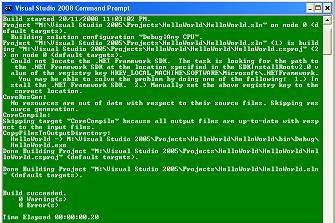 Well, who doesn’t write tests and do continuous integration (CI) these days? Whether you use one of the many Cruise Control variants, or Team City or some other tool, you most likely get a handy colour coding of builds as either green or red (ie, good, or bad). But, you can take this a step further!
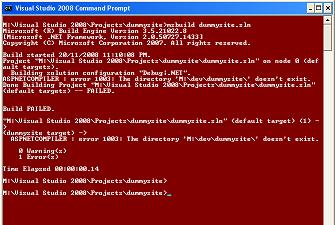 Often on .NET projects, we have a little batch file that we run before checking in (often with a pause at the end so it can be run from a shortcut), to confirm that no tests are broken locally. Well, it’s not much fun peering at the ugly Nant output (or whatever build system you use). Instead, it is quite easy to add a couple of lines to your batch file and change the colour of the console to bright Red or bright Green depending on the success of the local build. It is great for telling what the result was at a glance. I can’t claim credit the idea – it was something we used at EDI for our custom build system, but here’s some batch file code I whipped up which I can claim is all mine, every last GOTO of it! Enjoy 🙂
The following code uses NAnt, but you can replace it with MsBuild or any other build tool that returns a status code.
@echo off

color 07

tools\\nant\\NAnt.exe -buildfile:mybuild.build %*

IF ERRORLEVEL 1 goto RedBuild
IF ERRORLEVEL 0 goto GreenBuild

:RedBuild
color 4F
goto TheEnd

:GreenBuild
color 2F

:TheEnd
pause
This evening we had the first Sydney Alt.Net meeting. It went really well. Our venue at the ThoughtWorks offices was pretty packed with about 35 interested people coming along. We started with a discussion of news in the .NET space, and then broke for food. After that we had my presentation on Ruby & Rails from a .NET perspective, followed by Richard’s presentation on Rhino Mocks. We ended with a retrospective to gather feedback and thoughts for future meetings. Thanks to everyone for coming along and making it such a great night! And also a big thank you to ThoughtWorks for the venue, food and drink.
Here’s the slides from “Ruby and Rails from a .NET perspective”. It’s a bit hard to give you a transcript of the demos but here is a taste of some of the ruby commands we looked at today.
Basic IronRuby Console demo
4+4
"hello".class
$friends = ["James", "Richard", "Bill"]
$friends.find_all { |f| f.include? "a" }
$friends.collect { |f| f.length }
"-" * 100
$person_type = Struct.new(:name, :age, :sex)
$j = person_type.new("James", 27, "m")
Iron Ruby Calling WinForms
require 'System.Windows.Forms, Version=2.0.0.0, Culture=neutral, PublicKeyToken=b77a5c561934e089'
Form = System::Windows::Forms::Form
MessageBox = System::Windows::Forms::MessageBox
Button = System::Windows::Forms::Button

$b = Button.new
$b.text = "Hello Button"
$f = Form.new
$f.controls << $b
$f.show_dialog
Simple Rails App Demo
rails myapp
ruby script/generate scaffold Person name:string age:integer
rake db:migrate
ruby script/server
Exciting news! We now have an ALT.NET group in Sydney! Our first meeting is Tuesday 30 September. Meetings will be the last Tuesday of the month.
Rough agenda for the first meeting is:
6:00pm Meet & Greet time and then Kick Off!
6:30pm “Ruby, Rails and IronRuby from a .NET perspective” (me).
7:00pm Break with food and drink
7:30pm “Mocking with Rhino Mocks 3.5” (Richard Banks).
8:00pm Wrap up & go home.
ThoughtWorks is sponsoring the event with a nice office location in the CBD, and also pizza and beer. So if you’re planning to come, please comment or send me or Richard Banks a mail to help us get enough food and drinks for everyone.
Address is:
Level 8, 51 Pitt Street
Sydney NSW 2000 Australia
[Map]
ALT.NET is about designing and building the best solutions possible. This means continuous improvement, retrospection and often reaching outside the mainstream, considering Open Source frameworks and tools, Agile methodologies and ideas from other language communities such as Ruby, Java and Haskell.
For more info about ALT.NET, check out our Sydney ALT.NET Blog, and the main ALT.NET wiki.
See you on the 30th!
I’ll be giving a talk at the ACS (in Sydney CBD) on 1 October, about REST, designing good RESTful systems and implementing them in .NET. It will be quite similar to the REST Patterns in .NET talk I gave at Tech Ed. For more information, please check out the blurb at the ACS site.
Here’s the slides from “REST Patterns and .NET”. I’ve put some extra info in the notes on various slides, so suggest browsing with notes displayed.
You might also be interested in more information about the talk or the simple rest client with code I mentioned during the presentation.